Welcome to VRChat Success Stories! In this entry, we’re looking at one of the platform’s breakout worlds of 2026: Froggi’s A Game About Crates. We’ll get into what he built, what it earned, and what lessons he learned along the way.
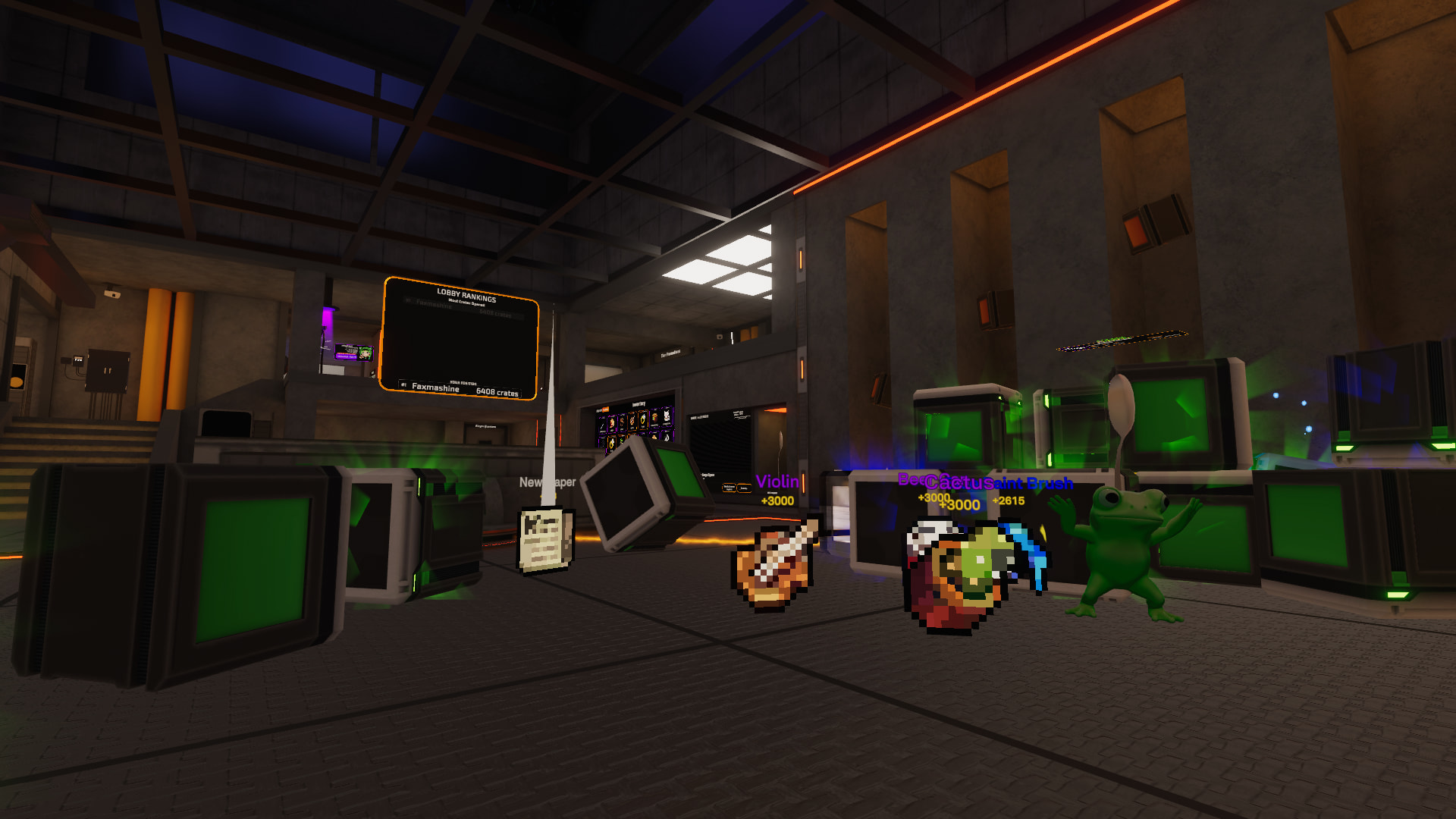
There’s Loot in Those Crates
We’re only halfway through the year, and Froggi’s A Game About Crates has already generated over six figures.
Immediately after the world’s launch, it was earning more than $10,000 daily. While that number dropped over time, it spiked again with the Fabricator Update, with over $5,000 of sales in its opening weekend, a pattern that has continued every time Froggi releases an update for his world.
For a game that spawned from an early-morning joke about “wanting to open CS:GO crates without spending money,” those are absurd numbers. Likewise, it’s even more impressive when you realize Froggi had built A Game About Crates in only a handful of months.
While all of these big numbers are certainly eye-catching, there’s one in particular that means the most to Froggi: A Game About Crates has made enough money to bankroll future development for the next 3+ years. Not to mention, it’s let Froggi bankroll a team for his next adventure.
“My expectations were basically zero,” he says. “I came into this wanting to see what I could do.”
Here’s how he did it.

A Game That’s Honest About What It Is
A Game About Crates is aptly named. It’s a “Numbers Go Up” incremental game built around loot crates, upgrades, gear crafting, and the occasional frog-spawned anomaly. You smash boxes, watch the credits roll in, and spend it to get better at blowing up (sometimes!) crates. Early on, that’s the whole loop. It’s simple!
It gets deeper than that, though.
The more crates you annihilate, the more the game turns into a series of small bets about where your effort should land this session. Exactly how you go about your crate-smashing session evolves and expands, keeping you coming back.
To put it another way, like all great games, it’s incredibly basic on the surface, but unravels over time. This way, anyone can pick it up without getting buried in the details. And hey, if nothing else, don’t you want to see what all these machines do?

The Systems That Bring People Back
Everything a player earns — achievements, upgrades, levels, currency, progression — is saved through VRChat’s Persistence system, so none of that grind evaporates when they log off. On top of that foundation, two systems do most of the work of keeping people invested.
The first is the Research System, Froggi’s take on the classic skill-point mechanic.
You get a limited supply of tokens, but each one costs progressively more of the investment you’d otherwise spend elsewhere. That means that people have to take a little time to think about whether the choice they’re about to make is actually worth it.
“I hear people say ‘Oh, I’m running my research today, getting some extra tokens for this upgrade,’ with others saying ‘I’m just going to focus on cascades for a while and stockpile these buffs.”
Cascades are the second system at play: the game’s prestige mechanic.
Cascades require you to sacrifice your levels and upgrades for a large permanent buff. Once again, this adds weight to your choices. Do you want to really press that button or do you want to keep grinding with what you have?
While those two systems form the foundation, Froggi has continued to build on them over time. The recent Fabricator Update added random stats and gear crafting, opening up a whole new layer for players to min-max.

Crates Are Better in a Crowd
Of course, in VRChat, one of the best ways to make your world more successful is to make it social. We talked a bit about that in the last Success Story! Unfortunately, Froggi had a problem: when A Game About Crates launched, people treated it like a solo experience.
The instances were silent. People played alongside each other, but not really with each other.
Anomaly Crates changed that. Every 5–6 minutes, a “mini-boss” crate spawns somewhere random on the map, and players have 40 seconds to destroy it for the rewards inside. The twist is that it scales with the instance. More people mean bigger rewards, but also a tougher fight.
Since the update, public lobbies have roughly 4x’d their player counts, going from 2–3 instances to 4–5 full ones at any given time.
Some people treat it like parallel play on a Discord call, cracking jokes while they open crates. Some lean into the bit, roleplaying as diligent “good employees.” And when an Anomaly Crate spawns, you’ll see genuine cooperation, with supporters using a perk to fly around the map and flag where it landed so everyone can converge in time.
Returning players built up recurring characters and inside jokes. Early on, dedicated players chased the top leaderboard spots.
Players have made fake crate-worker uniforms; some group instances have invented their own lore, decorating the place with corporate memos and union posters.
“Seeing that dedication and interaction with a game I made is just so humbling,” says Froggi.

Monetization That Feels Like a Gift, Not a Toll
Froggi monetizes broadly but deliberately, following a specific rule: every purchase should feel worth it to the buyer.
There are premium tool-skin bundles, lobby-wide stat boosters, supporter bundles that unlock skins, new areas of the map, a tag above your head, and convenience purchases that shave extra clicks out of the game. That last category, the small, make-my-life-easier buys, turned out to be the most popular by far.
Froggi mostly steers away from subscriptions (he offers exactly one through the Creator Economy, plus tiered Patreon support across all his worlds) because the bulk of their earnings come from small purchases people find genuinely valuable, plus a social dynamic he didn’t fully expect: “hey, look at this cool tool skin I own.”
The Creator Economy makes that skin customization possible without ever pushing anyone off-platform, and the core game stays free for everyone who just wants to break boxes.

What Other Creators Can Learn
Froggi’s been making worlds for about six years and has shipped 15 of them, with hundreds more that he never released or quietly pulled down. A few things from his path are worth stealing:
Bake in translations from the start. Given how many players turned out to be Japanese, Froggi noted that he wished he had built that support for non-English languages from the very beginning. Always keep in mind that VRChat has many different communities – and they often speak different languages!
Everything counts in large amounts. Creators often shy away from small purchases, but these are often low-friction, providing players with an easy way to grab something valuable. Don’t fall into the trap of thinking that you need to only offer “big,” cool items. Sprinkle in some fun for everyone.
Just make anything. “Don’t go into world creation attempting to perfect it on your first one,” he says. The 15 released worlds exist because of the hundreds that didn’t. Finishing rough things teaches you more than polishing one thing forever.
Ship early and listen. He ran public playtests before there was any art in the game at all, which let players steer the design before it calcified. Early versions were being pulled in too many directions until that feedback helped him land on the version people actually wanted.
Limitations are a feature. Maybe the most counterintuitive takeaway: “VRChat’s limitations with Udon… is actually a blessing in disguise. I would not have finished this game without those limitations keeping my scope creep and ideas in check.”
One thing Froggi noted we thought was especially important was to be social and meet other creators. Don’t build your world in a vacuum! “Go to meetups, join Discords, and just chat with people,” says Froggi.
Some of Froggi’s closest friends are fellow creators, and they openly share ideas, tips, and data to make everyone’s projects better.
Start Building
For both new creators and seasoned builders, the VRChat Creator Economy is a practical way to turn the thing you’re already making into something that can sustain you, without asking your players to leave the platform to support you.
A Game About Crates started as a 3 AM joke and a screen full of grey boxes. It’s now someone’s livelihood, a community with its own lore, and the funding behind whatever Froggi builds next.
Apply now to join the Creator Economy and open up an entirely new way to bring in income through your worlds. Submit your application